


Fintech GEO in 2026: The Five Signals AI Checks Before Citing You
Google's Top-10 rankings now drive just 17–38% of AI citations. What fintech content needs before an AI model will cite it, and how to fix yours in a week.

Most of the GEO advice circulating right now was written with SaaS and e-commerce in mind, where visibility behaves like a content-and-authority problem.
If you publish enough, get linked enough, the AI models start naming you.
But that's not enough for the finance industry. If you're running content for a payments company, a lending platform, or anything else that touches someone's money, following the generic GEO playbook won't make your brand visible in AI Search.
One note on the name, because everyone has their own: you'll see AEO, LLM optimization, AI search optimization. The Princeton researchers who published the original paper called it Generative Engine Optimization, so GEO is what I use.
Ahrefs and BrightEdge both tracked the overlap between top-10 Google results and AI Overview citations, and it fell from 75% in 2025 to 17%-38% in 2026.
Most of what AI cites now comes from pages that never reach Google's first page at all.
SEO and AI rankings overlap has dropped in every industry but finance has the widest gap. There are two reasons for that:
Financial content sits inside YMYL (Your Money or Your Life) so models apply tighter checks before repeating anything in that bucket
AI platforms carry real liability exposure when they point someone toward a financial product
This ultimately means that a fintech with high domain authority can pull zero citations if its pages are missing disclosures or verifiable data.
Here's how I explain it to clients. AI assistants are behaving like a reporter deciding whether to run a story on a single anonymous source.
It has a claim in front of it, but also a liability sitting behind it if the claim turns out wrong, and it wants a second source before it puts its name on anything.
So you can have strong authority, a full content calendar, and a team hitting every deadline, and still show up nowhere.
I've watched it happen with content that was genuinely good, just because the page had no named author, or a rate claim with nothing behind it, so the AI models went with a competitor pulling half the traffic.
55% of Americans use AI to help with financial management decisions, up from 10% the year before (TD's 2026 U.S. AI Insights Report)
67% of borrowers expect AI to inform their next borrowing decision (PwC's Consumer Lending Radar Survey 2026)
51% of B2B software buyers open vendor research with an AI chatbot instead of Google, up from 29% in just a year (G2's 2026 AI Search Insight Report)
$750 billion in US revenue is projected to flow through AI-powered search by 2028, with unprepared brands seeing traditional search traffic fall 20–50% (McKinsey)
Only 16% of brands track how they perform in AI answers
Put that last number next to the four above it and you have the actual problem. The demand has already shifted, and almost 85% of the companies are not prepared to face the change.
When someone asks an AI assistant which payment processor or lending platform to use, every candidate claim runs through the same review.
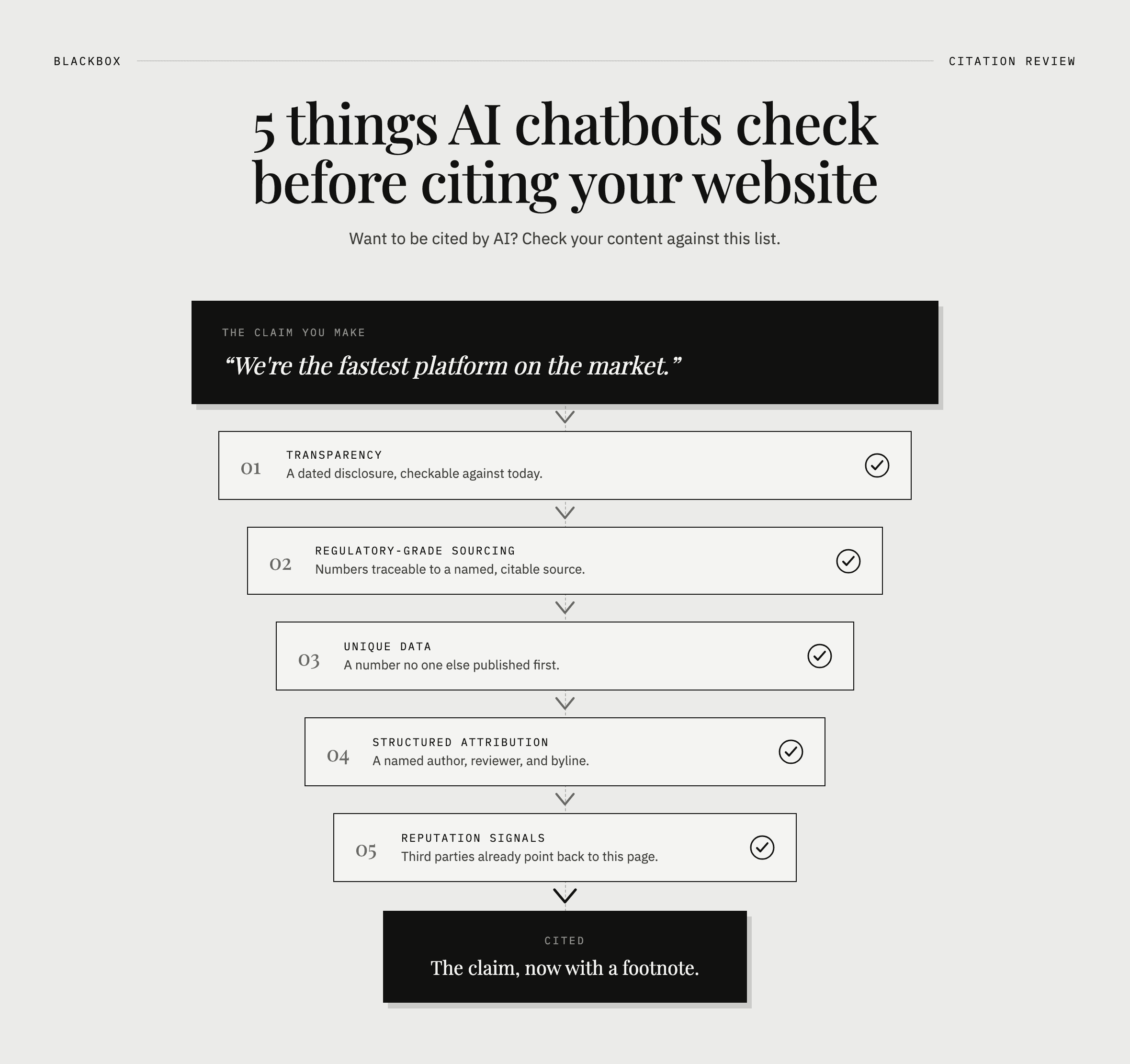
This is the framework I use to diagnose it with clients.
Disclosures, licensing details, effective dates.
AI reads them as risk clearance before quoting a claim. A pricing page with a dated disclosure gets treated differently from one without.
Claims that are traceable to verifiable primary data (rates, terms, filings) an AI can check.
"Competitive rates" is unverifiable, so it gets skipped but "As of March 2026, our average was X against a category average of Y from [source]" is a claim the model can follow.
Content built on journalistic-quality research that produces information gain (content that adds something instead of restating what's out there).
Research from Princeton, and Georgia Tech found that adding statistics improved AI visibility by 41%.
Named authors with credentials, reviewer bylines, license numbers where they apply with references to regulatory compliance.
The model essentially wants somebody accountable for the claim.
Concrete data points (growth metrics, partnerships, market position) reinforced by third-party coverage.
Earned media accounts for roughly 82% of AI citations in search queries. Growth metrics, partnerships, market position, backed by third-party coverage
Your own site saying you're the fastest is a claim waiting on a second source; a trade publication saying it is the second source
Ramp reworked its content around how people actually phrase financial questions to an AI assistant, rather than how they type them into a search bar.
Their visibility in fintech-category AI answers jumped about sevenfold, moving from 19th to 8th in category rankings.
iPullRank documented a similar case where a fintech platform's AI-optimized content pulled its traditional SEO rankings up at the same time; helpful when you're defending the budget for it.
The pattern I keep seeing is that AI citation follows verifiability more closely than it follows domain authority.
The brand AI can independently check is the brand AI names.
Your dashboard's missing crucial data: Referral data won't surface AI citations, so if this channel is already shaping consideration, your reporting says nothing is happening.
Compliance moves to the front of the process: Disclosures and legal review have always been the last gate before publishing, the step everyone works around. They're now part of what makes a page eligible at all.
Your most polished content may be your least citable: A thought-leadership piece with no byline and no data loses to a plain comparison table with a named author and a source link.
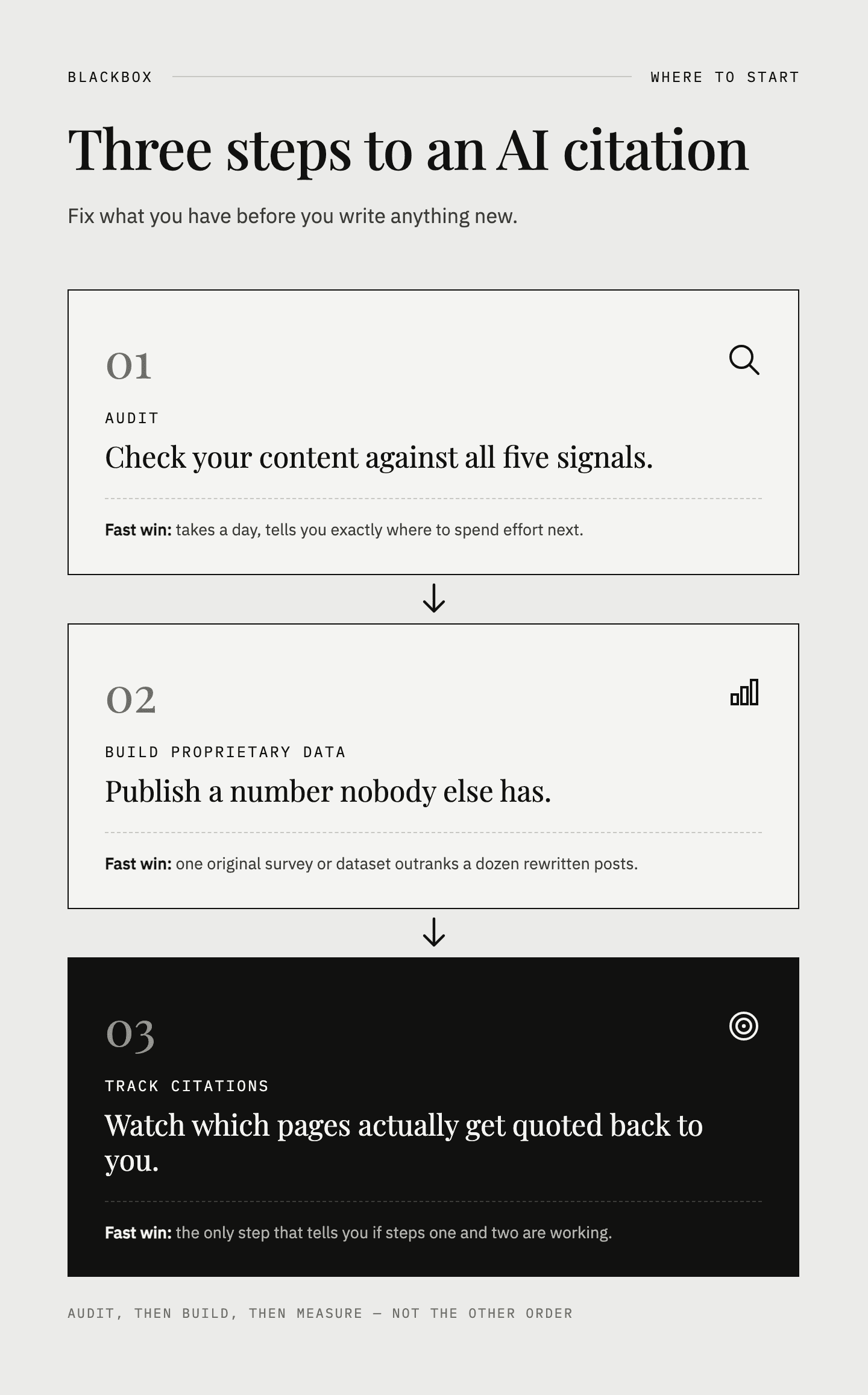
Here are 3 simple steps your team can start executing today to get better GEO results.
Pull your highest-traffic pages and check each against the five signals.
Missing author credentials and disclosures are the fastest fix and the biggest blocker, and you can usually clear a dozen pages in a week.
Rate benchmarks, approval-trend data, comparisons nobody else has run.
It doesn't need a research department behind it. It just needs to be something a competitor's rehashed content can't match.
Set up direct citation tracking so you're watching the channel instead of inferring it.
This is usually the fastest way to show leadership the channel is real, before you ask for a bigger content budget.
None of this needs a bigger content team. The five signals are mostly things you already have sitting somewhere in the business; the compliance language legal wrote two years ago, the credentials in someone's LinkedIn bio, the rate data ops pulls every month that nobody publishes.
The work is getting it onto the page in a form a model can verify.
The urgency comes from that 16%. Every fintech is competing for the same AI answers.
55% of Americans are already using AI for money decisions and 51% of B2B buyers are opening their research in a chatbot, and almost nobody is watching whether they show up in any of it.
While that's true, fixing bylines and disclosures across twenty pages can move you several positions in a category.
Once citation tracking becomes standard practice, that advantage gets a lot more expensive to buy.
If you want to know how your brand is showing up in AI search, talk to Blackbox about building an AI-native content and GEO strategy.
Southern, Matt G. "Google AI Overview Citations From Top-Ranking Pages Drop Sharply." Search Engine Journal, March 2026. Reports Ahrefs' study of 863,000 keywords and 4M AI Overview URLs, and BrightEdge's February 12, 2026 analysis. https://www.searchenginejournal.com/google-ai-overview-citations-from-top-ranking-pages-drop-sharply/568637/
Profound. "How Ramp Increased AI Brand Visibility 7x in Accounts Payable." Customer case study. https://www.tryprofound.com/customers/ramp-case-study
TD Bank. 2026 U.S. AI Insights Report: Artificial Intelligence at the Consumer Inflection Point. March 31, 2026. Survey of 2,500+ US adults. https://stories.td.com/volumes/default/2026-TD-AI-Insights-Report.pdf
PwC. Consumer Lending Radar Survey 2026: AI Ambition Meets Consumer Reality. June 1, 2026. Survey of 4,100 US borrowers, fielded February 2 – March 15, 2026. https://www.pwc.com/us/en/industries/financial-services/banking-capital-markets/consumer-finance/consumer-lending-radar.html
G2. The Answer Economy: How AI Search Is Rewiring B2B Software Buying. April 15, 2026. Survey of 1,076 B2B software buyers, March 2026. https://learn.g2.com/g2-2026-ai-search-insight-report
Silliman, Elizabeth, Julien Boudet, and Kelsey Robinson. "New Front Door to the Internet: Winning in the Age of AI Search." McKinsey & Company, October 16, 2025. Source of the $750B projection, the 20–50% traffic-decline range, and the 16% tracking figure. https://www.mckinsey.com/capabilities/growth-marketing-and-sales/our-insights/new-front-door-to-the-internet-winning-in-the-age-of-ai-search
Aggarwal, Pranjal, Vishvak Murahari, Tanmay Rajpurohit, Ashwin Kalyan, Karthik Narasimhan, and Ameet Deshpande. "GEO: Generative Engine Optimization." Proceedings of ACM SIGKDD 2024. Princeton University, Georgia Tech, IIT Delhi, and the Allen Institute for AI. https://arxiv.org/pdf/2311.09735
Muck Rack Generative Pulse. "What Is AI Reading?" May 2026 edition. Analysis of 25M+ links cited by ChatGPT, Claude, and Gemini across 17 industries. https://muckrack.com/blog/what-is-ai-reading-may-2026

